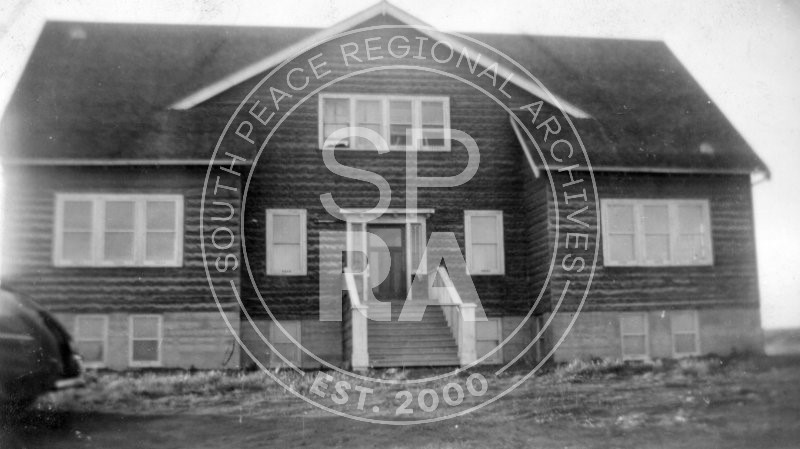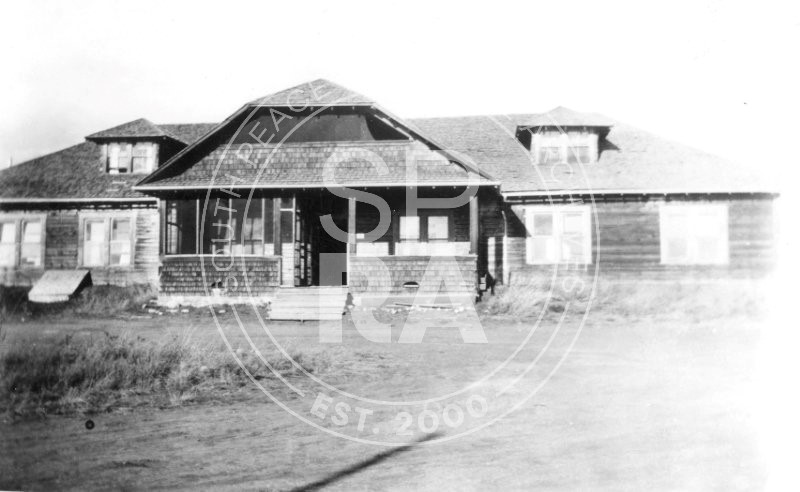
Image above: The Pioneer Hospital, later re-named the Kathryn Prittie Hospital, was built in 1914. (SPRA 1969.42.01.3)
Rose Pitts, born Rose Kelly in Ontario in 1878, lived a life marked by resilience, independence, and an unwavering commitment to healthcare. The youngest of seven children, Rose lost both of her parents before the age of ten and was largely raised by her older siblings. She married at the age of seventeen, but by 1910 was living independently and pursuing a nursing education in Vernon, British Columbia. After becoming a registered nurse, Rose worked in hospitals across North America, including in Seattle and Pittsburgh, gaining valuable experience while satisfying her love of travel and adventure.
In 1915, the growing community of Pouce Coupe requested a registered nurse or doctor to be sent to the region as they were too far from necessary medical services. Rose answered the call and became the first registered nurse to reside there. She arrived with an ambitious vision: to establish a hospital in a rural community that desperately needed one. However, convincing residents of the importance of a local hospital proved difficult. Many families were accustomed to receiving care at home, and community support for the project was very limited.
Undeterred, Rose moved to Grande Prairie in 1916, where she briefly served as the third matron of the Kathryn Prittie Hospital. Still determined to achieve her goal, she later settled near Beaverlodge and attempted once again to establish a hospital. Despite her efforts and the support of local resident Doss Johnson, the project never materialized. Her only patient in Beaverlodge was Doss himself in her own home. Rose continued to live independently, tending her farm on her own with some aid from her neighbors, and continued to serve her community as best she could.
When Rose passed away in 1958, family members discovered boxes of carefully stored medical supplies in her home, many untouched for decades. It was as though she had never stopped believing that one day her dream would become a reality. Though she never succeeded in opening the hospital she envisioned, Rose Pitts’ dedication to increasing accessibility and improving healthcare in rural communities remains an inspiring part of South Peace history. As her daughter Eunice later wrote, “To me, my mother was a very colorful figure and I don’t think she should die without recognition.”