

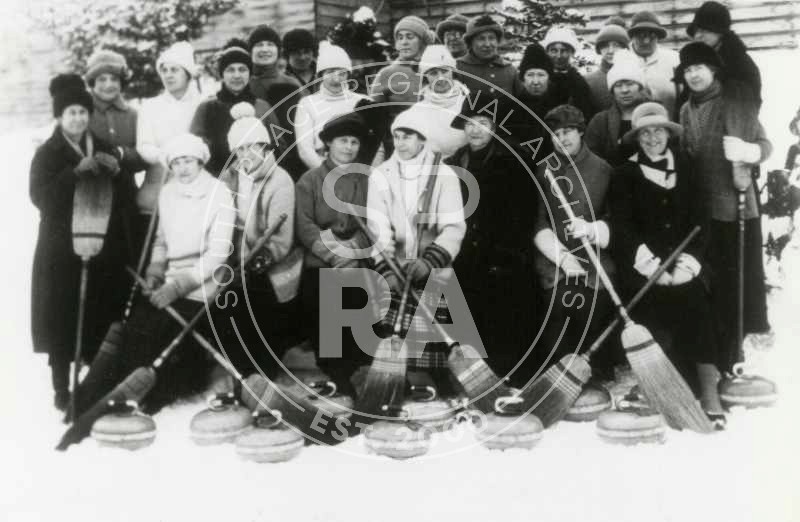
Image above: The Grande Prairie Ladies’ Curling Club posed with rocks and brooms. Front row, left to right: Mrs. MacPhee, Mrs. Harmer, Mrs. O’Brien, Mrs. Grisdale, Mrs. Christie, Mrs. W. C. Pratt, and Mrs. Porteous. Second row: Mrs. James, Mrs. Graban, Mrs. Turner, Mrs. D. W. Pratt, Mrs. Percy Jones, Mrs. Hackett, Mrs. McMillan, Mrs. L. Smith, and Mrs. Bell. Back row: Mrs. ? (Bill Storm), Mrs. Mead, Mrs. Thomson, Mrs. Minchin, Mrs. (F.) Flood (J. Patterson), Miss James, Mrs. F. McDonald, Mrs. Fredette, and Mrs. Howell. Mrs. Evans was away. Ca. 1925. (SPRA 0032.08.08.0767)
Edith Louise Hibbs was born in Montreal on November 14, 1889. After training as a nurse, she was working in London, Ontario when she enlisted with the Canadian Army Medical Corps in September 1915 during the First World War. Her military service took her overseas to Malta, Turkey, the Dardanelles, and England, where she cared for wounded and ill soldiers under challenging conditions. The demands of wartime nursing took a toll on Edith’s own health, and she contracted malaria several times between 1916 and 1917. Despite these setbacks, she continued working in military hospitals for the remainder of the war. In recognition of her exceptional dedication and service, Edith was awarded the Royal Red Cross by King George V in 1919, one of the highest honours for military nursing in the British Commonwealth.
Following the war, Edith worked as a hospital matron in Summerland, British Columbia. It was there that she received an invitation from Dr. Lewis J. O’Brien, a physician she had met while serving overseas. In 1923, she accepted his offer to become matron of the Kathryn Prittie Hospital in Grande Prairie and made the journey north to the growing Peace Country.
The hospital Edith joined was a far cry from modern healthcare facilities. The small log building had no running water, limited electricity, and relied on horse-drawn water deliveries in the summer and ice blocks in the winter. Nurses performed countless tasks by hand, from washing newborns to sterilizing equipment and laundering surgical supplies. Despite these challenges, Edith helped provide essential healthcare to residents arriving from across the Peace Region.
When a larger, more modern hospital opened in Grande Prairie in 1929, Edith became its first matron, helping guide the transition into a new era of healthcare. Later that same year, she married local veterinarian Dr. Louis Fredette and stepped away from her nursing leadership role. As one of the pioneering healthcare professionals in Grande Prairie, Edith’s contributions to healthcare during both wartime and peace helped improve the lives of countless people, securing her place among the remarkable women who shaped the history of the South Peace region.