

In the early 20th century, the agricultural industry was growing in the Peace Region. Grain and other agricultural products were transported to British Columbia and shipped around the world from seaports in the province. By 1936, there was no direct route from the Peace Region in Alberta to British Columbia. This meant that products from the Peace Region had to travel on an indirect route through Edmonton, and money was lost in transportation fees. Naturally, the people of the Peace Region wanted a direct route to British Columbia.
A local Metis man named Alexander Monkman would propose the solution to this problem. In the 1920s, Alexander was trapping in the area southwest of Beaverlodge, near the Rocky Mountains. Following old trails and natural geographical passes, Alexander found himself on the other side of the Rocky Mountains near Hansard, British Columbia, west of Prince George. After realizing this area was being surveyed by the Grand Trunk Railway, he knew he had found the easiest route from the Peace region through the Rocky Mountains. This route would then be named the “Monkman Pass”. Alexander tried to bring this to the attention of rivaling railways, the Canadian National Railway and the Canadian Pacific Railway. Though a surveyor did come, they expressed no interest in the project.
Despite the lack of interest by railway companies in developing this route, developing the pass was not abandoned. Peace Region locals pushed instead for the Monkman Pass to be developed into a fully functioning highway. In 1936, the Monkman Pass Highway Association was officially formed. In an informational poster, the goals of the association were explained:
There has been shipped out of the Peace River Country in a single year 20 million bushels of grain, besides sufficient seed and feed requirements. There has been shipped out on a single shipment 130 cars of livestock. The bulk of these shipments eventually leave Canada through western Canadian Ports. All of these products have to travel to the port of Vancouver or Prince Rupert via Edmonton, and three quarters of wholesale imports come from Vancouver. Realizing all these facts, the people of the Peace River have been urging the Monkman Pass project for the last decade.
The association pointed out that the Monkman Pass Highway would save 900 miles on transportation of the Peace Region’s products. This meant that travelling to Vancouver from Grande Prairie would be 760 miles instead of 1600.
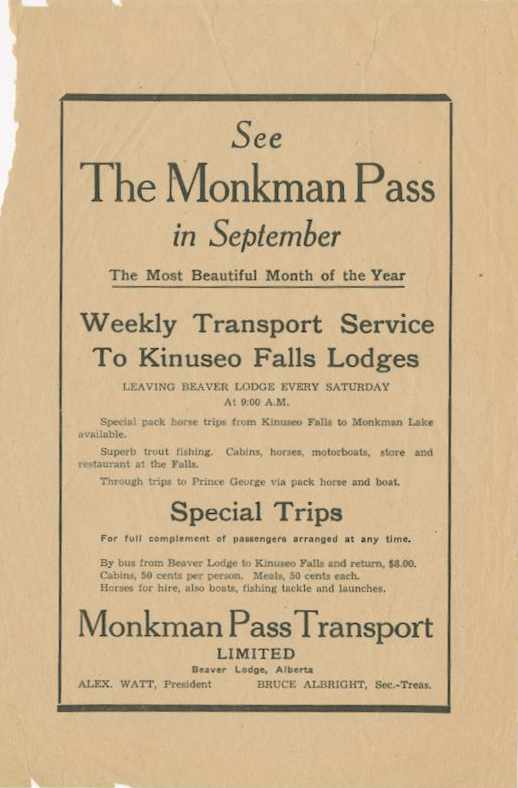
Despite lobbying efforts by the association, neither provincial nor federal funding was provided. Fundraising in the Great Depression also proved to be challenging for the association. However, the people of the Peace Region met these challenges head-on. Locals banded together to take on the project. In a time when cash was tight, locals volunteered, donating their time and goods towards the cause. Men volunteered for a month at a time, clearing the roads. Those who couldn’t work donated food and equipment. Women joined the effort as cooks as well. Even children took part in clearing light debris from the roadway. The association sold memberships, had contests, and even dabbled in tourism to raise cash for the project.
Even though there was tremendous support for this project over several years, and much of the trail was cleared, the Monkman Pass Highway never came to fruition. This is most likely due to the outbreak of World War II, as volunteering capacity waned with men leaving for war. Though the Monkman Pass Highway was never finished, it is still used today as a scenic hiking route.